
new project
I designed new project :)
User reaserch
How leads are managed before they become customers
To understand how leads are handled in day-to-day work, I interviewed four professionals who manage incoming inquiries across different service businesses. I asked the same ten questions about lead sources, prioritization, follow-up, team ownership and conversion.
Who I spoke with
Ruti
Clinic Owner
Dan
Business Owner
Nadav
Account Manager
Erez
Operations Manager
From interviews to patterns
Each color represents one participant. I grouped recurring behaviors and breakdowns to identify the problems shared across different workflows.


Key findings
Lead information lives everywhere
Details are spread across WhatsApp, email, calendars and partial systems, leaving no complete view of each lead.
Follow-up relies on memory
Personal reminders and manual workarounds cause leads to be missed or contacted too late.
Ownership and progress are unclear
Before a deal is confirmed, teams often cannot see who is handling the lead, its current status or the next step.
The core problem
Small service businesses need a shared way to capture, track and follow up with leads because their current tools do not provide a clear view of ownership, history or next steps.
Product direction
What the product needed to solve
Capture every lead, effortlessly
Bring inquiries from every channel into one place, without stopping to complete a form.
Turn follow-up into a clear next action
Show the current status, priority, next step and follow-up date, so leads no longer depend on personal memory.
Make ownership visible
Give every lead a clear owner and allow the team to see who is handling it, what has already happened and what comes next.
From interviews to patterns
Each color represents one participant. I grouped recurring behaviors and breakdowns to identify the problems shared across different workflows.

Researching the content editor experience
I focused on the content editor side of modular CMS platforms to understand which controls are exposed to non-designers, what stays fixed, and how editors build pages within predefined structures.
These references helped shape the controls, presets and limitations built into Clal’s system.
Contentful
Structured component editing
Predefined fields and settings inside a fixed component structure.

Storyblok
Section-level content contro
Editors update content within predefined page components.

Shopify
Modular page composition
Predefined sections with controlled layout and content settings.

Across all three systems, editors work within predefined structures rather than designing freely.
Building the system
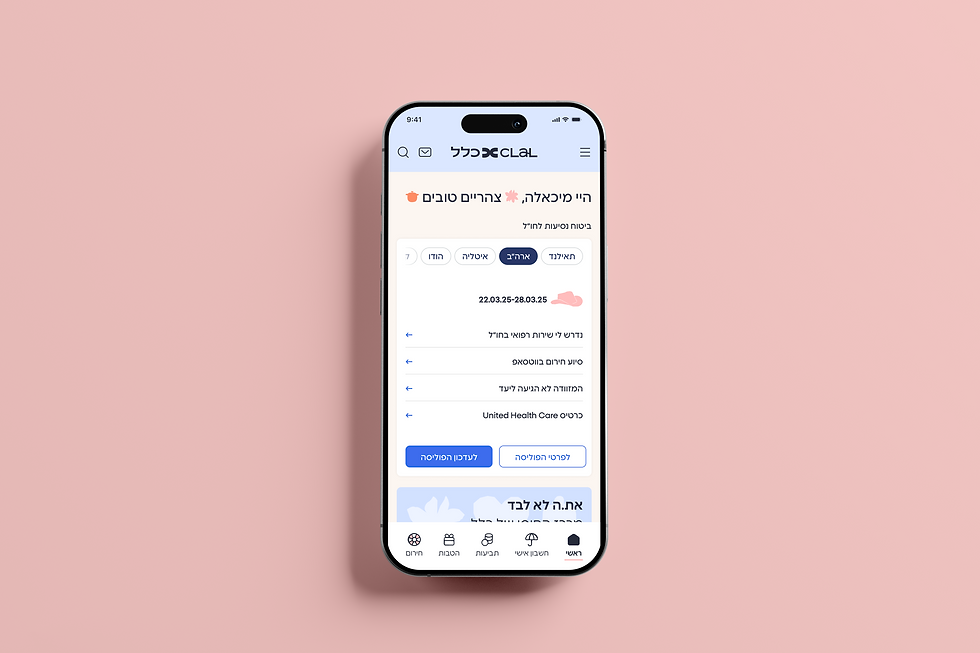
I translated Clal’s design language into a modular system of predefined page sections. Content editors could combine sections to create different page structures, while the design rules inside each component remained controlled.
1. Modular page sections
Pages are built by combining predefined sections in different orders, allowing editors to create different page structures without designing new layouts from scratch.

2. Controlled typography
Editors can choose from predefined heading styles and approved font weights, while sizing and hierarchy remain fixed by the system.

3. Controlled color options
Selected components include approved color options for backgrounds and visual elements, all taken from Clal’s existing visual language.

4. Predefined CTA options
Primary and secondary button styles are built into the components, with predefined one- and two-CTA configurations.

5. Built-in responsive behavior
Each component includes predefined behavior across screen sizes, removing the need to redesign or manually adapt every page for desktop and mobile.

Flexible in composition, controlled by design.

Fixed structure
Layout, hierarchy, spacing and responsive behavior were defined in advance.
Controlled options
Editors could choose only from approved styles and variations within each section.
Flexible composition
Sections could be combined and reordered to support different page needs.
Different combinations, one consistent system.
Reducing design dependency
Today, many pages can be built and published by the content team without designer involvement. When design support is still needed, it is often limited to providing images in predefined dimensions removing much of the back-and-forth around layout, sizing and repeated adaptations.
60%
less design time spent on routine page production
Estimated reduction based on the typical design involvement required before and after the new system.
Measured performance improvements
Pages built with the new system showed faster visual loading and lower blocking time across the sampled pages compared with the legacy setup.
56% lower median Speed Index
Faster visual loading across the sampled pages.

47% lower LCP
Main content appeared sooner.

81% lower TBT
Less time spent blocking the browser.

● New system ○ Legacy
Lower values indicate faster loading
The result was a scalable content foundation that enabled faster publishing, reduced design dependency and supported more consistent page experiences across Clal’s website.
Liat Zini
More Works

ForkCheck
Insurance Cards
